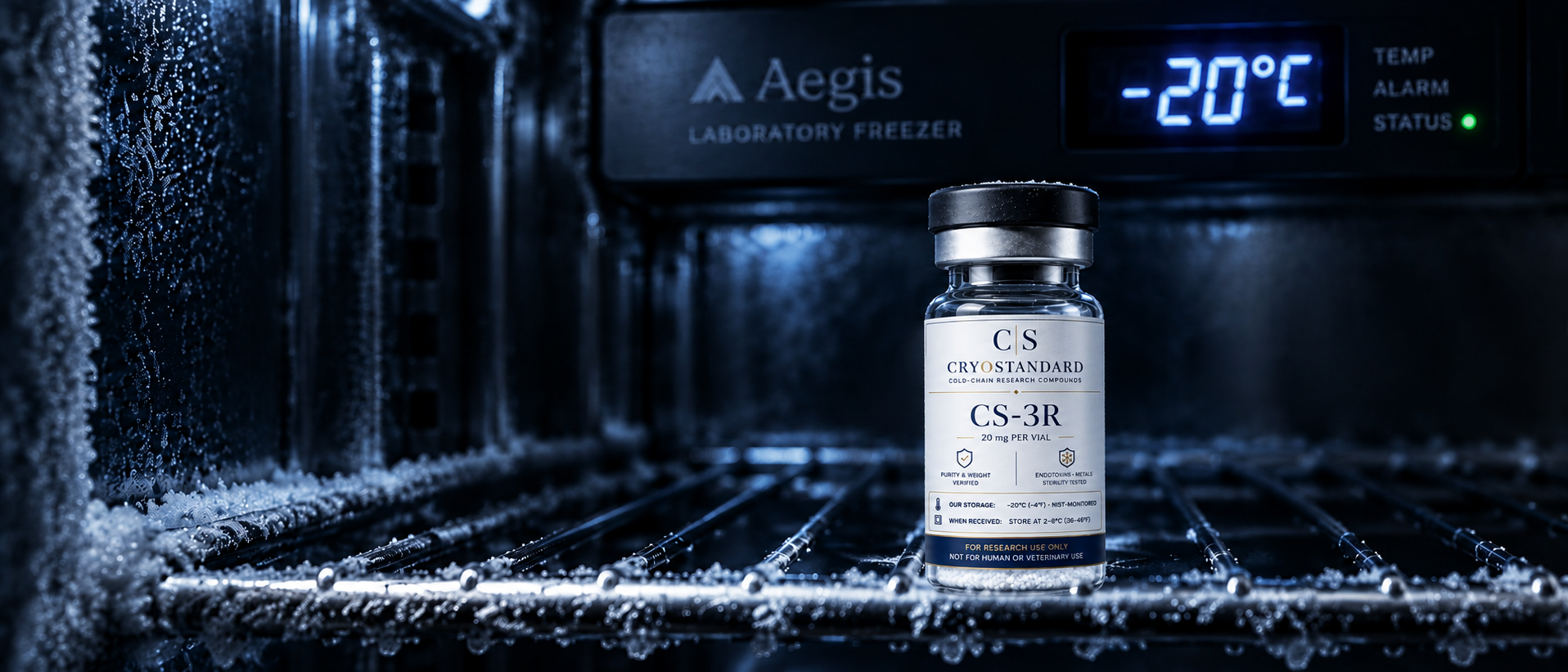
Cold Chain Monitoring: How It Works and What to Record
Cold chain monitoring is the continuous measurement of temperature for temperature-sensitive materials in storage and transit. A system logs readings against set limits and alerts someone when conditions drift so action can be taken before material is compromised.
For research compounds, the practical questions are straightforward: Where are sensors placed? How often do they log? How long are records kept? What happens if a freezer drifts? This guide covers those points using common lab practices, then shows how we apply them at CryoStandard.
TL;DR
- Cold chain monitoring means automated logging of temperature in storage and transit, with alerts that reach someone who can act.
- For research materials, useful systems log frequently, use calibrated sensors, and keep records that can be reviewed later.
- Remote alerts matter most outside normal hours.
- When a deviation happens, record the temperatures reached, how long it lasted, which lots were affected, and what was done.
- Our research compounds are held at −20°C under continuous NIST-traceable monitoring. Temperature records are available with each order.
What cold chain monitoring covers
The cold chain is the series of refrigerated steps a material goes through from production to final storage. Monitoring makes each step visible instead of assumed.
A basic monitoring setup has three parts:
- Sensors placed in the freezer or shipping package
- A system that stores readings with timestamps
- Alerts that notify someone when readings leave the set range
Without alerts you only have a record. Without sensors you only have assumptions.
For laboratory buyers, the highest-risk points are often after a package leaves the supplier — on a dock, in transit, or while waiting to be transferred into monitored storage. Fast receiving and placement into controlled storage reduces that risk.
How continuous temperature monitoring works
Continuous systems use electronic loggers that record temperature inside freezers or cold rooms and send the data to a platform. Alerts can be sent by email, text, or app when limits are crossed.
Common practices in research settings include:
- Logging multiple times per hour
- Keeping records for an extended period so they can be reviewed later
- Using sensors that are calibrated against a traceable standard
- Setting alerts so someone is notified outside normal working hours
Manual checks still have value. A quick look at the display and alarm status a couple of times a day helps confirm the system is working as expected.
Monitoring methods and sensors
Different tools exist depending on the setup:
- Programmable remote systems with multiple sensors for larger storage areas
- Data loggers for individual freezers or studies
- Batch-level trackers for shipments
Sensor accuracy matters. A sensor that is consistently off creates false confidence. Most lab procedures call for periodic calibration against a traceable reference, with certificates kept on file.
Temperature is not uniform inside a freezer. Door seals, shelves, and airflow create warmer and colder spots. Placing the permanent sensor in a representative location gives a more useful reading. Sensitive material is best kept away from the warmest areas.
Monitoring a freezer remotely
Remote monitoring means a sensor inside the freezer sends readings to a service that can notify you when limits are crossed. The practical steps are:
- Register contact details before material is stored
- Set the alert range to the material’s storage requirement
- Confirm that alerts reach someone who can respond outside normal hours
- Keep a simple list of which units are monitored and where the sensors are
Responding to a temperature excursion
If an alarm occurs, a short documented response is better than none:
- Note the highest and lowest temperatures reached and how long the unit was outside range.
- Identify which lots were in the unit.
- Record what was done (quarantine, transfer, repair, etc.).
- Note the likely cause if known (door left open, power event, overloaded shelf).
A short log entry is usually enough: unit ID, time of alarm, peak reading and duration, lots affected, and corrective action taken.
What to look for from a supplier
If you buy temperature-sensitive research materials, the supplier’s storage conditions become part of the material’s history. Reasonable things to ask about include:
- A defined storage temperature that is held continuously, not only at the moment of shipping
- Sensors calibrated to a traceable standard, with records available on request
- Temperature records that can be provided with an order
- Lot-level third-party testing and a certificate of analysis
- Insulated packaging appropriate for the expected transit time
Our approach at CryoStandard
Most temperature issues with research materials do not happen inside a well-monitored freezer. They happen in the gaps — after a package leaves a facility, while it sits on a receiving dock, or over a weekend when no one is checking a display.
We hold research compounds at −20°C under continuous NIST-traceable monitoring so the record exists whether or not someone is on site. Temperature records are available with each order. Each lot is also tested by a third-party laboratory for purity, quantity, endotoxins, and heavy metals, with certificates of analysis provided.
Our compounds are supplied for in vitro and laboratory research only. Not for human or veterinary use.
Cold-chain research compounds from CryoStandard
If your lab needs research-use-only compounds with documented storage conditions, we supply them with lot-level testing and certificates of analysis. Material is held at −20°C under continuous NIST-traceable monitoring and ships in insulated packaging.
Browse the catalog for specifications and available certificates. Institutional and bulk orders are available.
FAQ
What is cold chain monitoring?
Continuous measurement of temperature for sensitive materials in storage and transport, with alerts when readings leave set limits so corrective action can be taken.
How often should temperature be recorded?
Multiple times per hour is common for continuous systems. Records should be kept long enough to review if questions arise later.
How often should sensors be calibrated?
At least once a year against a traceable reference is standard practice in most lab settings. Calibration certificates should be kept on file.
How can I monitor a freezer remotely?
Use a sensor that sends readings to a cloud service and notifies you by text, email, or app. Set the correct range, register contacts before storing material, and confirm that out-of-hours alerts reach someone who can respond.