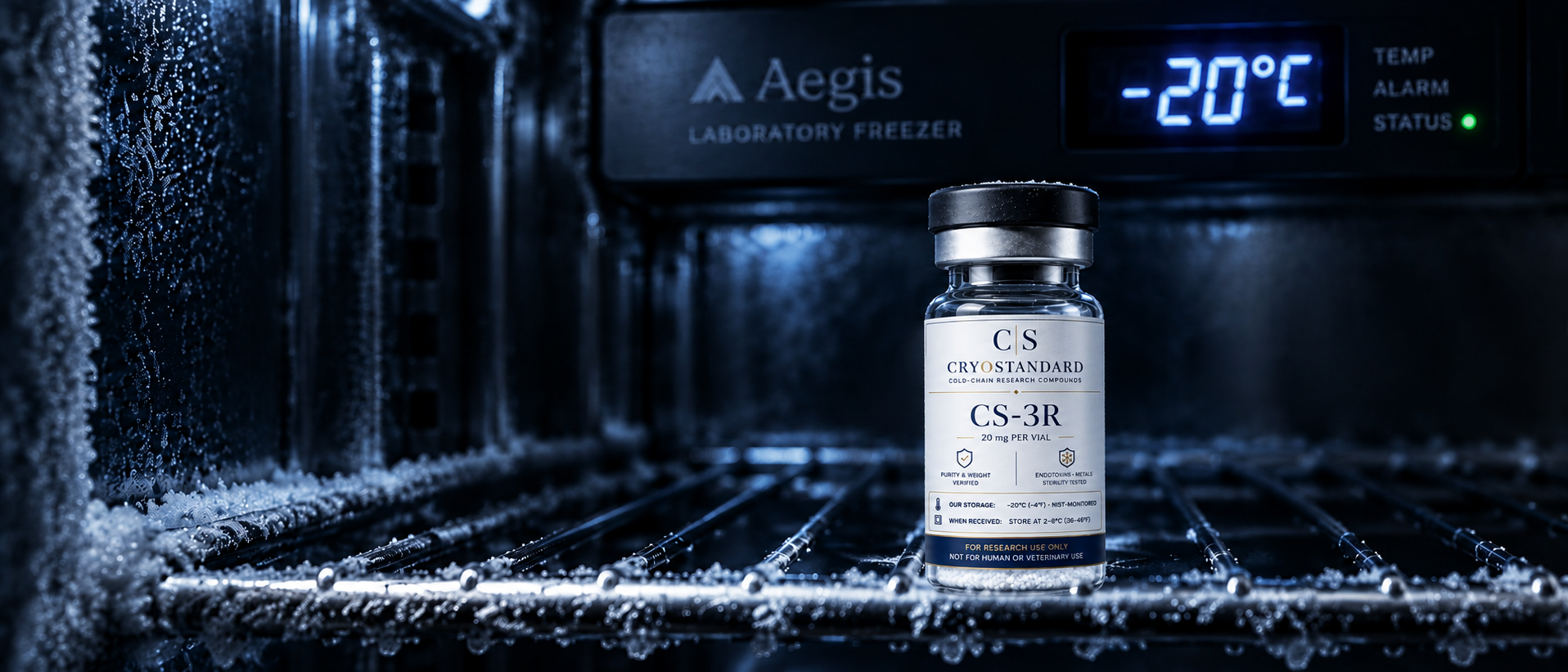

Cold Chain Packaging: How Insulated Shipping Protects Research Materials
How cold chain packaging works, from insulation and refrigerants to standards like ISTA 7D and IATA PI 650, plus what to check when a research shipment arrives.
Read articleResearch access
CryoStandard supplies research compounds exclusively to qualified researchers and laboratories for in vitro and laboratory use. Please confirm before continuing.
By proceeding, you affirm the statements above are true. Products are for laboratory research use only and are not for human or veterinary use.
Not a researcher? Exit
−25.9°CCompound StorageLive
CryoStandard
How cold chain packaging works, from insulation and refrigerants to standards like ISTA 7D and IATA PI 650, plus what to check when a research shipment arrives.
Read article
How long peptides last as lyophilized powder, in solution, refrigerated or frozen, what degrades them, and how labs test and protect stability.
Read article
How to verify a peptide lot number: what the vial label must show, how to match it to the certificate of analysis, what CAS numbers prove, and what to do on a mismatch.
Read article
How cold chain monitoring works for research materials: sensor placement, temperature logging, remote alerts, calibration and documented excursion response.
Read article
How to store research compounds in a freezer: the right temperature, frost-free freezer risks, aliquoting, moisture control and records, with sources.
Read article
Cold chain monitoring explained for labs: sensors, logging intervals, calibration, remote alerts and excursion response, with sources and a −20°C storage example.
Read article
How to choose reagent and research compound storage temperatures, from room temperature to -80°C, and how to monitor, document and respond to excursions.
Read article
What HPLC-tested compounds really means: how purity is calculated, what an impurity profile shows, what HPLC can't prove, and how to read a lot report.
Read article