Reagent and Compound Storage Temperature: A Practical Guide for Labs

The right storage temperature for a reagent is the one the supplier states on the label and the Safety Data Sheet (SDS), held without interruption. Most reagents sit in one of four bands: room temperature, refrigerated (2–8°C), frozen (-20°C), or ultra-low (-80°C). Which band applies depends on the chemistry, the form (dry or in solution), and how long you plan to keep it. This guide shows how to pick the band, protect material from freeze-thaw damage, and document what happened when a freezer misbehaves.
TL;DR
- Start with the supplier’s stated condition and the SDS (sections 7, 9, and 10), then adjust only with stability evidence.
- The four common bands are room temperature, 2–8°C, -20°C, and -80°C. Colder is not automatically better: some solutions precipitate or freeze and break bottles.
- Avoid repeated freeze-thaw cycles by aliquoting, and rotate stock first-in-first-out.
- Log temperatures continuously and treat any deviation from labeled conditions as an excursion to investigate and quarantine.
- For research-use-only compounds and compounds held at -20°C, request storage and temperature records that cover both the freezer and the shipment.
Table of Contents
- How to decide the storage temperature for a reagent
- What each temperature range means
- When colder is not better
- Limiting freeze-thaw damage and contamination
- Monitoring and documenting storage temperature
- Judging shelf life and fitness for in vitro work
- Sourcing research compounds with the cold chain intact
- FAQ
- Sources
How to decide the storage temperature for a reagent
Three sources, in this order, settle most questions.
- The label and supplier documentation. Commercial reagents should be stored as the provider recommends, according to harmonization guidance from the Global Bioanalysis Consortium. The WHO Laboratory Quality Stepwise Implementation tool says the same: supplies go where the supplier indicates, whether that is room temperature, 5°C, -20°C, or -70°C.
- The Safety Data Sheet. The French research organization CNRS points to the SDS as a reference document for storage temperature. Its guidance lists the useful sections: Section 2 (hazard identification), Section 7 (handling and storage, which may give minimum and maximum temperatures), Section 9 (physical and chemical properties, including melting and freezing point), and Section 10 (stability and reactivity).
- The chemistry itself. When documentation is thin, the physical behavior of the material decides. A University of Rochester chemistry department guide sorts reagents by where they belong: on the shelf if they are thermally stable, not volatile, and not sensitive to moisture or oxygen; in a desiccator if they have some moisture or oxygen sensitivity; in a glovebox if they degrade extensively in lab air; in the refrigerator if they are heat-sensitive, decompose over days or weeks at room temperature, are volatile, or are highly reactive; and in the freezer if the label says to freeze or if they are very volatile and stay liquid when frozen.
The best temperature for a biological reagent also depends on the material type, the solution it is in, its intended use, and how long it will be stored, as Azenta Life Sciences notes. That is why two reagents in the same lab can need different conditions even when they look alike on the shelf.
A short decision path
- Does the label give a temperature? Follow it.
- No label temperature? Check SDS Section 7, then Section 10.
- Is it a dry solid or a solution? Solutions are usually the more fragile form.
- Will you use it within days or hold it for months? Short-term and long-term conditions often differ.
- Still unsure? Contact the supplier before the material is committed to an experiment.
What each temperature range means
The table summarizes the four bands labs use most. Ranges are typical; the supplier’s value always wins.
| Band | Typical range | Typical use | Watch for |
|---|---|---|---|
| Room temperature | 15–27°C | Stable solids, preserved specimens, many solvents and salts | Heat, humidity and light |
| Refrigerated | 2–5°C (often written 2–8°C) | Frequently used enzymes and antibodies, heat-sensitive reagents | Salt or detergent precipitation |
| Frozen | -20°C | Reagents not stable at warmer temperatures | Freeze-thaw cycles, frost-free defrost swings |
| Ultra-low | -80°C | Long-term storage of nucleic acids, proteins and other biomolecules | Cost, power resilience, rapid thaw handling |
The room temperature, refrigerated, and -20°C descriptions follow Azenta’s overview: room temperature (15°C to 27°C) suits materials fixed with a preservative such as formalin or alcohol, 2°C to 5°C suits short-term storage of frequently used reagents such as enzymes and antibodies, and -20°C suits short-term storage of reagents that are not stable when warmer. The same source describes -80°C freezers as a practical option for long-term storage, because ultra-low temperatures prevent the degradation of nucleic acids, proteins, and many other biological molecules.
For critical reagents in ligand binding assays, the Global Bioanalysis Consortium recommends long-term storage at -60°C or below unless there are specific known stability issues or evidence that another temperature is adequate. That is a useful benchmark for assay-critical material you cannot easily replace.
Why temperature matters so much
The WHO tool states that storing supplies under the appropriate conditions prevents premature degradation. As a rule of thumb, reaction rates rise steeply with temperature, so a reagent that is stable for a long time in a freezer can lose quality quickly on a warm bench. You do not need the exact kinetics to act on that: every hour out of range is a cost, and it is cheaper to prevent than to diagnose.
When colder is not better
It is tempting to put everything in the freezer. The Rochester guide cautions that very few reagents really need to be there, and that before cooling a bottle you should consider whether its contents might freeze and break it.
Practical examples of mismatches:
- Solutions that freeze. Water-based solutions expand on freezing. Check fill level and container rating before you move a bottle to -20°C.
- Solutions that precipitate in the cold. Concentrated salt buffers, SDS solutions, and concentrated urea can come out of solution at refrigerator temperatures, according to a molecular biology reagent handling guide. If that happens, check the supplier’s recommendation before redissolving or discarding.
- Conjugates that should not be frozen. The Global Bioanalysis Consortium notes that some suppliers advise keeping enzyme-conjugated antibodies at 2 to 8°C, or at -10 to 30°C in 50% glycerol, which lowers the freezing point, rather than freezing them.
- Unstable chemicals that need tight control. For organic peroxides, CNRS says temperature must be controlled permanently, and that the set point is generally 10 to 20°C below the lowest temperature at which the peroxide can decompose in its packaging (the Self-Accelerating Decomposition Temperature) when that is below 50°C. Cold storage for hazardous chemicals is a safety question, not only a quality one.
Limiting freeze-thaw damage and contamination
Once the band is chosen, handling decides whether the material still performs on day 90.
Aliquot before you freeze
Multiple freeze-thaw cycles generally reduce enzymatic activity and can affect protein stability, per the Global Bioanalysis Consortium. Divide a new lot into single-use aliquots at the start, label each with lot number, date, and concentration, and thaw only what an experiment needs. Slow freezing and fast thawing are the usual advice for cells; Azenta describes freezing at about 1°C a minute and thawing quickly in a water bath.

Keep chemical hazards apart
The WHO tool also asks that flammable supplies go in a fire-resistant cabinet, poisonous supplies in a well-ventilated room or cabinet, and corrosive substances in corrosion-resistant cabinets, trays, or containers. Temperature is one axis of storage; compatibility is the other.
Rotate stock
WHO describes first-in-first-out: lots nearest their expiration date go at the front of the shelf so they are used first. Pair it with a simple inventory sheet that records the date received, date opened, and the storage location.
Plan for the whole chain, not only the freezer
Many degradation problems start before the vial reaches your freezer: a courier hold, a warm loading dock, or a cold pack that has run out. When you receive material, record the arrival condition, the packaging state, and the time it was moved into storage. If the supplier supplies temperature records, file them with the lot paperwork.

Monitoring and documenting storage temperature
A freezer display is a reading, not a record. Good practice is continuous logging with alarms, plus a calibrated reference for the sensor.
- Log continuously and review trends, not just alarms. A freezer that cycles wider every week is telling you something.
- Use calibrated probes. Traceability to a recognized standard, such as NIST in the United States, makes your readings defensible when someone questions a result.
- Place probes where the material is, not only near the door or the display.
- Write the response procedure down. Who is called, what is moved, where, and who decides.
What to do after an excursion
The Irish regulator HPRA, in its guide to control and monitoring of storage and transportation temperature, defines an excursion as a deviation from labeled storage conditions for any duration, in storage or transport. It says all excursions should be promptly and thoroughly investigated, and that products in the affected area should be quarantined until the investigation concludes. It also advises consulting the manufacturer on possible quality impact, then identifying and implementing corrective actions to prevent a repeat, all described in a procedure. The guide is written for medicinal products in Ireland, but the logic carries over to laboratory reagents.
A workable bench-level version:
- Isolate and label affected material as quarantined.
- Record the duration and the highest or lowest temperature reached.
- Ask the supplier whether the material tolerates that exposure.
- Decide, with documented criteria, whether to use, test, or discard.
- Fix the cause and note it in the equipment log.
Judging shelf life and fitness for in vitro work
An expiry or retest date is a starting point. The Global Bioanalysis Consortium advises that when a lab monitors or tests reagent stability, it should define how, who is responsible, where the data are kept, what criteria apply, and where the work is documented. It also says the scope of testing should match the needs of the assay life cycle and the instability risk of the reagent.
In practice, that means:
- Run a reference sample or control alongside each new lot or after any storage event.
- Set an acceptance window before you test, not after you see the result.
- Keep the certificate of analysis (COA) with the lot record so you can compare purity at release with what you observe later.
- Retire material that fails the criteria, and note the lot in your log.
Our perspective on storage for research compounds
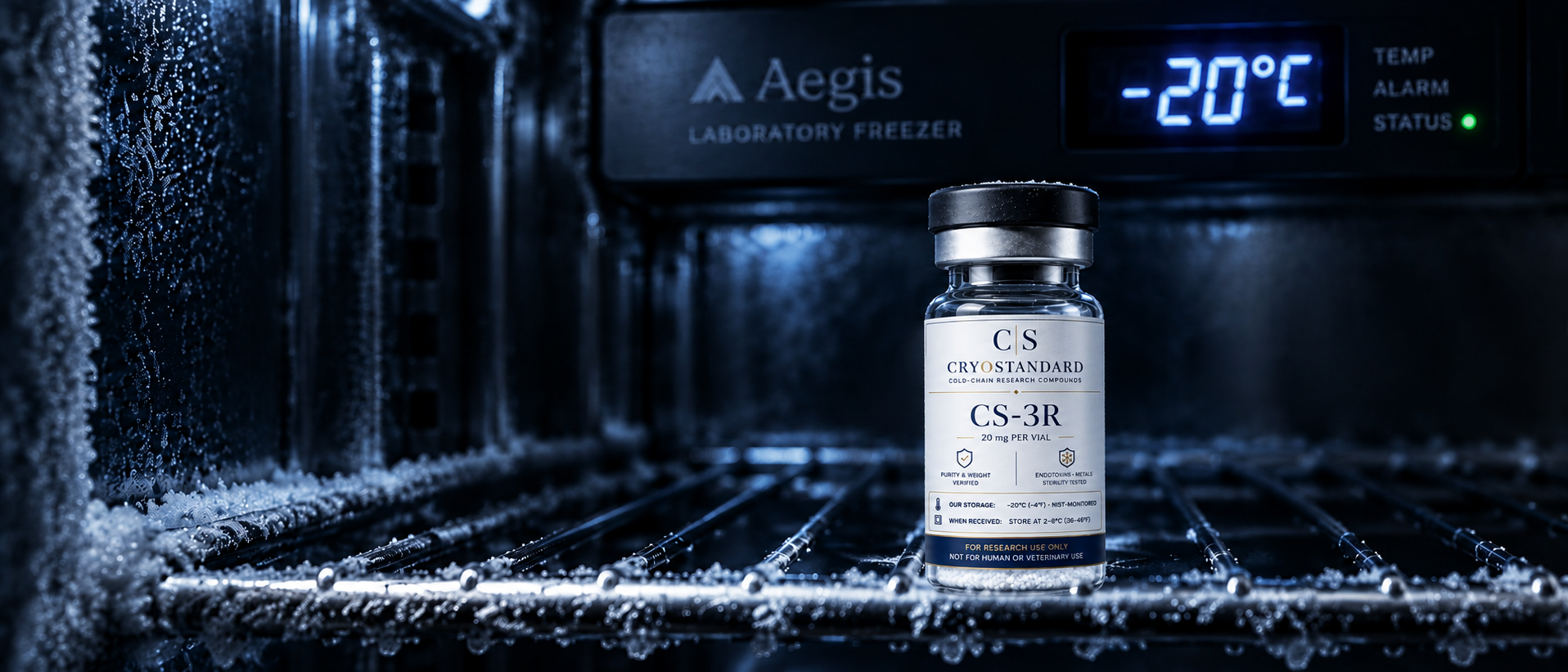
Most storage failures we hear about are not dramatic. A vial is fine in the freezer and the problem happened somewhere else: in transit, over a weekend, on a dock. That is why we treat temperature as a chain rather than a setting. Our research compounds and research-use-only compounds are held continuously at –20°C under NIST-traceable monitoring, and we ship in insulated packaging so the cold chain does not end the moment an order leaves our facility.
We also believe a storage claim should come with paperwork. Each order is accompanied by storage and temperature records, and each lot goes through testing for purity, endotoxins, and heavy metals with third-party analytics and a detailed certificate of analysis. For a lab, that means fewer unknowns to explain when a result looks odd, and less variability between experiments run weeks apart.
Our compounds are supplied exclusively to qualified researchers and laboratories, for in vitro and laboratory research only, never for human or veterinary use. Our standard is simple: the material you open should be the material you ordered.
Sourcing research compounds with the cold chain intact
When you buy research-use-only compounds or research compounds, ask the same questions you would ask of your own freezer: what temperature, measured how, recorded where, and for how long. At CryoStandard we hold materials at –20°C with continuous NIST-traceable monitoring and provide storage and temperature records with each order. You can read the details on our cold-chain standard page and see how lots are tested on our quality and testing page.
If you are ready to browse, the research compounds catalog lists what we supply to verified laboratories and professional researchers, and a product page such as GHK-Cu 50 shows the specification and COA for that item.

All products are for in vitro and laboratory research only, sold to qualified researchers and institutions.
FAQ
What is the best storage temperature for laboratory reagents?
There is no single best temperature. Follow the supplier’s label and the SDS, because the right condition depends on the compound, its form, and the planned storage time. Common choices are room temperature, 2–8°C, -20°C, and -80°C.
Is -20°C or -80°C better for long-term storage?
For assay-critical biological reagents, guidance from the Global Bioanalysis Consortium points to -60°C or below for long-term storage unless data support another temperature. Many other reagents are specified for -20°C by their supplier, in which case that is the condition to hold. Follow the documented requirement for the specific material.
How many times can I freeze and thaw a reagent?
As few as possible. Repeated cycles generally reduce enzymatic activity and can affect protein stability. Split new material into single-use aliquots so each vial is thawed once.
What counts as a temperature excursion?
Any deviation from the labeled storage conditions, for any length of time, in storage or in transport. Quarantine the affected material, investigate, and consult the supplier about whether the material can still be used.
Where do I find a compound’s storage temperature if the label is unclear?
Check Section 7 of the SDS for handling and storage, Section 9 for physical properties, and Section 10 for stability. If those do not settle it, ask the supplier in writing and keep the answer with the lot record.
Do research compounds have special storage requirements?
Most research-use-only compounds are specified for frozen storage. At CryoStandard, research compounds are held continuously at –20°C under NIST-traceable monitoring with temperature records available for each order.
Sources
- Ligand Binding Assay Critical Reagents and Their Stability (Global Bioanalysis Consortium Harmonization Team)
- WHO Laboratory Quality Stepwise Implementation tool: store supplies appropriately
- University of Rochester: how to store reagents
- CNRS: à quelle température stocker les produits chimiques ?
- Azenta Life Sciences: safe storage temperatures for biological materials
- HPRA: guide to control and monitoring of storage and transportation temperature conditions
- Guide to storing and handling chemical reagents for molecular biology