Cold Chain Packaging: How Insulated Shipping Protects Research Materials
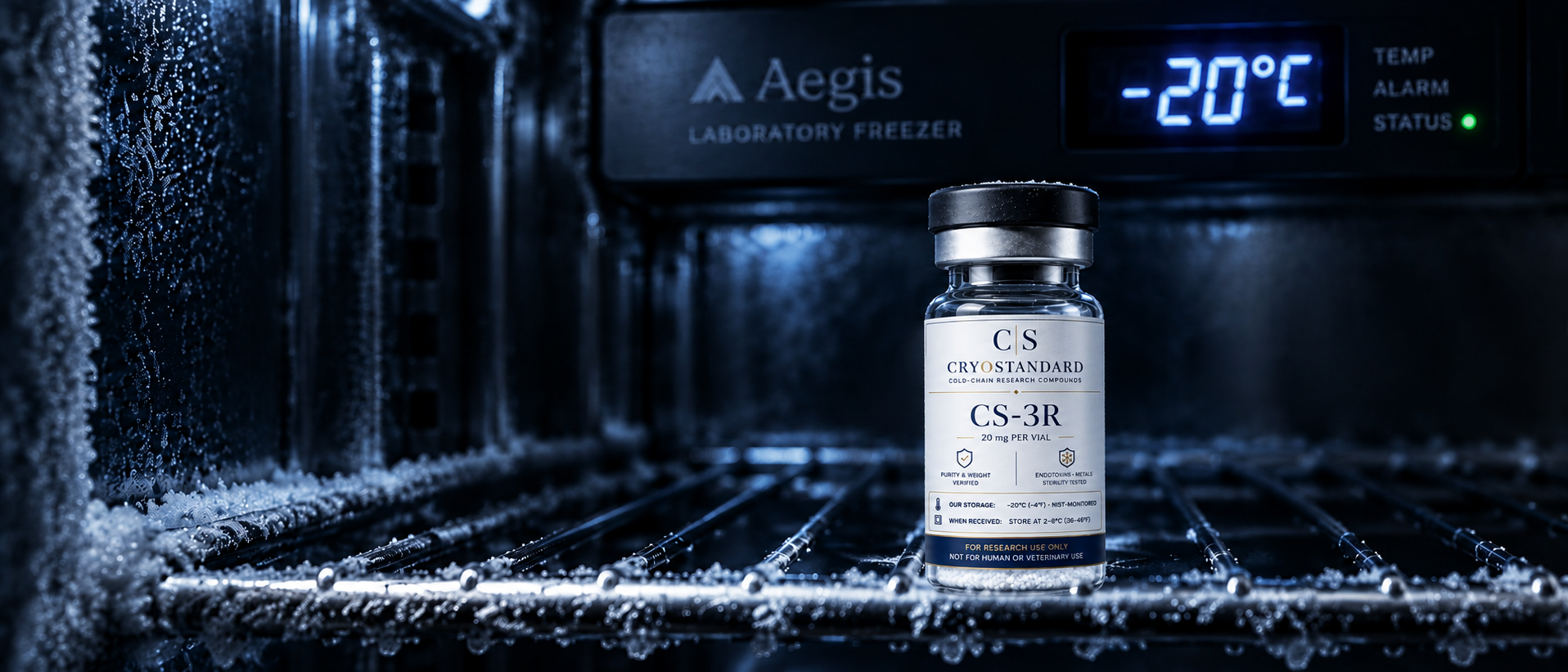
Cold chain packaging is a validated shipper, made of insulation, a refrigerant and protective inner packaging. It keeps temperature-sensitive materials inside a set range for a set number of hours. A good one is only half the job: the material must also be stored at the right temperature before and after the trip, and the temperature record must show it. That is why our research compounds are held at −20°C under continuous NIST-traceable monitoring, shipped in insulated packaging, and sent with storage and temperature records.
TL;DR
- Cold chain packaging is a passive, active or hybrid system built to hold a temperature range for a defined transit time. Most research shippers are passive: insulated box plus refrigerant.
- Choose packaging from the required temperature, the longest realistic transit time and the route, not from the box size or the price.
- Biological and research materials usually need triple packaging (primary, secondary, rigid outer). Air shipments with dry ice add venting and labeling rules.
- ISTA 7D, ASTM D3103 and PDA Technical Report 72 are the references for testing and qualifying a shipper.
- On arrival, check the delivery record, move the material to storage promptly, and quarantine anything that left its labeled range.
Table of Contents
- What cold chain packaging is, and what it protects
- How the pieces work together
- Packaging for peptides and other laboratory materials
- How to choose cold shipping packaging
- Standards and validation: what the references actually cover
- When the box arrives: verifying temperature and handling an excursion
- Why we ship the way we do
- Order from a documented cold chain
- FAQ
- Sources
What cold chain packaging is, and what it protects
Temperature-controlled packaging is one element of the wider cold chain. It is designed and validated to keep products within a specific temperature range for a given period. The ranges differ by product: many pharmaceuticals must stay at 2 °C to 8 °C, some materials must stay frozen, and others need controlled room temperature of 15 °C to 25 °C.
In a research setting, the same logic covers a long list of materials. Sources on lab shipping name research materials, enzymes, reagents, clinical and diagnostic specimens and cell therapy support materials. Manufacturer documentation for validated shippers lists cell lines, micro-organisms, proteins and other samples and solutions as typical contents. Peptides and other research compounds belong in the same family, because their purity depends on the temperature history they have seen.
The temperature target can sit far below a refrigerator. In one documented bioresearch case, pre-conditioned packaging with dry ice was used to deliver material at a precise −79°C, which the case describes as crucial for preserving sensitive materials. Your material has its own number. The packaging is chosen to match it.
How the pieces work together
Insulation, refrigerant and primary containers
A common passive shipper has an outer corrugated carton, an inner cooler, a refrigerant, primary containers and protective packaging. For air transport of infectious or biological substances, a leak-proof bag and absorbent are added.
There are three families of system:
| System | How it holds temperature | Typical refrigerants or power |
|---|---|---|
| Passive | Insulated packaging plus a refrigerant | Wet or dry ice, gel packs, foam bricks, phase change materials, liquid nitrogen |
| Active | Powered, refrigerated box or pallet shipper | Power source such as a lithium battery |
| Hybrid | Elements of both | Combination |
(Source for the table: the same IOPP guide.)
Phase change materials deserve a note. They are engineered to hold a particular temperature, which is how one shipper design can be configured for −20°C frozen, +5°C refrigerated or +20°C controlled room temperature loads.
The monitoring layer
Packaging that cannot prove what happened inside it leaves you guessing. Data loggers or chemical indicator strips supply the proof. WHO guidance says the point of a monitoring device is to determine whether product quality has potentially been compromised by harmful conditions, and that the device should be chosen against a written user requirements specification. The same WHO text says multiple-use devices should be calibrated against a certified, traceable reference standard once a year unless otherwise justified.
This is the reason we tie monitoring to NIST-traceable references. A reading is only as good as the instrument behind it. Our write-up on what cold chain monitoring records and why covers the logging side in more detail.
Packaging for peptides and other laboratory materials
Three layers, each with a job
Biobanking guidance describes sample packaging as three layers: a primary airtight container such as a cryovial or leak-proof tube, a secondary leak-proof device such as a plastic box or sealed pouch, and an external packaging device that protects the contents and maintains the cold chain, for example an isothermal box.
The same guidance explains the purpose. The packaging protects the material from breakage, protects staff and the environment from broken tubes, and preserves sample integrity by preventing exposure to less than optimal temperatures. A shipper that holds temperature but lets a vial shatter has failed. So has one that protects the vial and lets it warm.
Why frozen storage matters before the box is closed
The box only slows heat gain. It cannot restore material that was warm when it went in. That is why our approach starts upstream. Compounds are held continuously at −20°C with NIST-traceable monitoring, then shipped in insulated packaging, and the order comes with detailed storage and temperature records. The goal is a lower variability starting point for your experiment. Our cold-chain standard page sets out the storage side, and our guide to reagent and peptide storage temperature covers how to keep that temperature once the material is in your freezer.
How to choose cold shipping packaging
Choosing is a matching exercise between the product’s needs and the lane it will travel. The PDA Pharmaceutical Cold Chain Interest Group lists the factors that drive the passive-versus-active decision: regulatory requirements, load size, cost, availability, handling capabilities, temperature requirements and stability data, shipment duration, environment, controls along the lane and customer needs. Work through them in this order.
- Write down the required range. Ambient, 2–8°C, frozen or ultra-low each point to a different coolant and insulation approach. Lab packaging guidance says the product requirement controls which coolant and insulation approach is used.
- Fix the transit time, then add a buffer. Validation practice calls for a test duration matching transit time plus buffer. Weekends, customs holds and missed connections are the usual reasons a two-day trip becomes four.
- Judge the route. For a highly sensitive product on an international lane with possible delays, the sensible build is phase change material as the refrigerant, a higher R-value cooler such as polyurethane or vacuum insulated panels, and strong protective packaging.
- Match the season. Summer and winter profiles differ. A shipper that passes in October may not pass in July.
- Plan containment. Leak-proof primary and secondary layers, absorbent material and a rigid outer box are part of the design, not accessories.
- Decide how you will prove it. A logger in the load gives a record. Without one, you have only the outside of the box.
Lyophilized versus reconstituted
The state of the material changes the answer. One industry source notes that lyophilized peptides are relatively stable at ambient temperature for short transit periods of 24 to 48 hours, while reconstituted peptides and certain sensitive sequences need continuous cold chain at 2 to 8°C. For longer transit, insulated containers with gel packs or dry ice are essential. Our materials are shipped from −20°C storage in insulated packaging, and the storage and temperature records that accompany each order let your lab file the shipment history with the lot.
Standards and validation: what the references actually cover
Three names come up repeatedly. Knowing what each one covers saves you from reading the wrong document.
| Reference | What it covers |
|---|---|
| ISTA 7D | Summer and winter ambient temperature profiles, test durations, data logger placement and acceptance criteria for biological product packages |
| ASTM D3103 | Thermal resistance (R-value) of insulated shipping containers |
| PDA Technical Report 72 | Passive thermal protection systems: types, materials, qualification, operational use and reuse, and recycling |
Sources: ISTA 7D and ASTM D3103 summary and PDA TR 72 overview.
A full temperature validation includes the package system description, summer and winter challenge profiles, a test duration that matches transit time plus buffer, data logger calibration documentation, at least three replicates and pass/fail criteria. PDA TR 72 goes further into qualification steps, from user requirements and design qualification through distribution testing and performance qualification, and into handling steps such as inspection, assembly, shipment execution and destination receipt, per its table of contents.
Shipping rules that sit on top of temperature
Temperature performance is not the only requirement. For biological substances, Category B (UN 3373), IATA Packing Instruction 650 requires a primary receptacle, a secondary packaging and a rigid outer packaging. For liquids, the primary receptacle must be leakproof and hold no more than 1 L, and the outer packaging must hold no more than 4 L, not counting ice, dry ice or liquid nitrogen used to keep specimens cold.
If dry ice is the refrigerant, the same instruction says the packaging must permit release of carbon dioxide gas to prevent pressure build-up that could rupture it, and interior supports must hold the secondary packagings in place after the dry ice has dissipated. Dry ice is also a regulated hazardous material, so the air carrier’s own limits and labeling rules apply. For international air shipments, staff handling the packing need an IATA certificate. These are legal and safety requirements. Follow them every time, and confirm the current carrier rules for your lane before you ship.
When the box arrives: verifying temperature and handling an excursion
The delivery is where the cold chain either holds up on paper or does not. USP general chapter <1079> gives a clear receiving routine. Review the delivery document for shipment delays that could expose articles to temperature extremes, and move the articles into their designated storage environment within 2 hours of receipt. The same chapter says temperature records should be examined at least once every 24 hours, and that monitoring equipment should be calibrated regularly against NIST or international standards.
Receiving checklist
- Inspect the outer carton for crushing, wetness or tampering before opening.
- Read the logger or indicator and compare it against the range on the label.
- Check that primary containers are sealed and that nothing leaked.
- Move the material to its storage temperature within 2 hours and record the time.
- File the shipment’s temperature record with the lot number.
If the range was exceeded
A temperature excursion is a deviation from the labelled storage conditions for any duration, per the Irish regulator’s guidance. It says all excursions should be promptly investigated and affected products quarantined until the outcome is known. USP <1079> adds that you should document the reason and the action taken, quarantine the product and seek the supplier’s advice on its suitability before it is used.
Two practical points help the assessment. Mean kinetic temperature expresses a varying profile as a single equivalent temperature reflecting cumulative thermal stress, which compares to stability data better than a simple average. And a single excursion can degrade potency, alter physical characteristics or compromise sterility, so the decision belongs with whoever owns your quality procedures, not with whoever opened the box.
Why we ship the way we do
CryoStandard supplies research-use-only compounds, including peptides and specialized chemicals, to verified laboratories and professional researchers. They are for in vitro and laboratory research only, never for human or veterinary use. Our cold chain works on three points that map onto everything above:
- Storage: continuous −20°C holding with NIST-traceable monitoring.
- Shipping: insulated packaging, with detailed storage and temperature records provided with each order.
- Quality: lot-level testing for purity and sterility through third-party analytics, with certificates of analysis. See our quality and testing page.
Our view: the cold chain starts before the box
Most conversations about cold chain packaging begin at the shipper. We think they should begin at the freezer. A well-built insulated box protects a temperature that already exists. If material drifts warm on a shelf before packing, no refrigerant fixes that afterward.
That is why we hold every compound at a consistent −20°C and monitor it continuously against NIST-traceable references. It is also why each order carries storage and temperature records: your lab should see the history, not infer it. Variability in an assay often has a quiet cause, and uncontrolled temperature after shipment is a common one.
We built our process for researchers who need the material in the vial to match the certificate of analysis. Verified purity and sterility at the lot level, plus a documented thermal history, are how we try to take one variable out of your experiment.
Animal
Order from a documented cold chain
If your work needs research compounds that arrive with their thermal history on paper, our research compounds catalog lists what we supply to verified laboratories and professional researchers. Each lot is tested for purity and sterility, and tiered pricing is available for institutional and bulk orders.
Product pages such as GHK-Cu 50 carry the specification and certificate of analysis for the lot.
FAQ
What are the main types of cold chain packaging?
There are three: passive, active and hybrid. Passive systems pair insulated packaging with a refrigerant such as dry ice, gel packs, foam bricks or phase change materials. Active systems are powered, refrigerated boxes or pallet shippers. Hybrids combine elements of both, as described in the IOPP cold chain guide.
What standards apply to cold chain packaging?
ISTA 7D covers temperature profiles and acceptance criteria for biological product packages, and ASTM D3103 measures an insulated container’s R-value, per this validation summary. PDA Technical Report 72 covers qualification of passive systems. For biological substances by air, IATA Packing Instruction 650 sets the triple-packaging requirement.
How long can a shipper hold temperature?
It depends on the design, the refrigerant, the outside conditions and how it was conditioned. Validation tests the package against a duration equal to transit time plus a buffer, so the answer is the one proven for that specific configuration and season, not a general figure.
What should I do if a shipment arrives outside its temperature range?
Document the reason and the action taken, quarantine the material, and contact the supplier for advice on its suitability before use, following USP <1079>. Keep the logger data, because it is the evidence your quality team will assess.
Does the cold chain have to be maintained for peptides?
It depends on the state and the sequence. Short transit of lyophilized material is described as tolerable at ambient temperature, while reconstituted or sensitive material needs continuous cold, according to one industry guide. Our compounds are held at −20°C and shipped in insulated packaging.
Sources
- Shipping Temperature-Sensitive Materials (IOPP)
- Reliable Cold Chain Logistics for Bioresearch case study
- Tower KT400 product brochure
- Cold Chain Packaging for Lab Samples and Biologics
- Packaging and Shipment, Sample Management, Biobanking
- Thermal Packaging Validation: ISTA 7D, 7E and 20 Testing
- WHO TRS 961, Annex 9, Supplement 15: temperature and humidity monitoring systems
- PDA Technical Report 72 table of contents
- PDA Technical Report 72 preview
- IATA Packing Instruction 650
- USP <1079> Good Storage and Shipping Practices
- HPRA guide to control and monitoring of storage and transportation temperature conditions
- Temperature Excursion Management: A Decision Guide
- How to Travel with Research Peptides: TSA and Customs