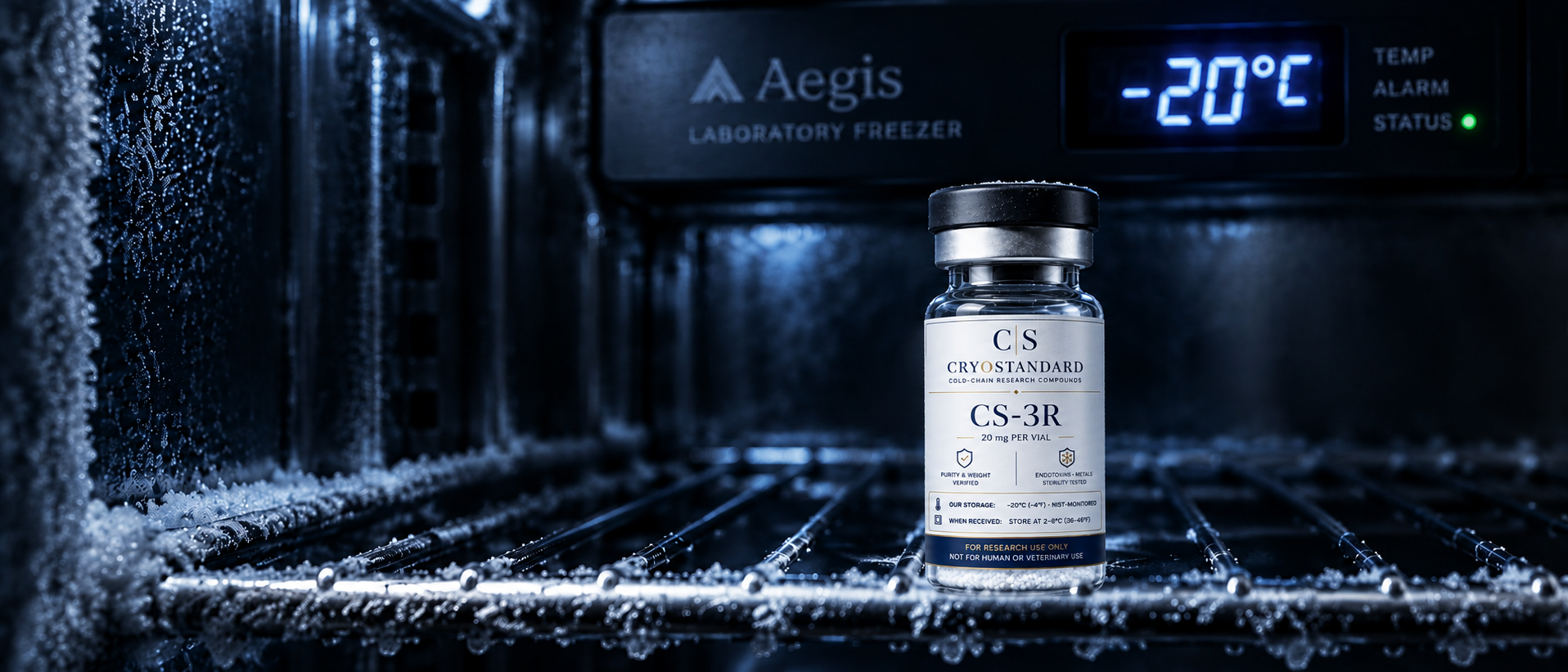
Lot Number Verification for Research Peptides: A Lab Guide
To verify a peptide lot number, read the code on the vial label, find the identical code on the certificate of analysis (COA), and confirm that the product name, issuing laboratory and test date on that COA also fit. If any of those fields disagree, put the vial on hold and ask the supplier in writing before it goes into an experiment. The steps below cover the whole check, including what a CAS number can and cannot tell you.
This guide is written for qualified researchers and laboratories handling compounds strictly for in vitro and laboratory research. It is not for human or veterinary use.
TL;DR
- The lot number is the link between the physical vial and its paper record. The COA is only evidence for your vial if the two codes match exactly.
- A usable COA also names the issuing laboratory, gives a plausible test date and carries a unique report number.
- A CAS number identifies the substance. It says nothing about the manufacturer, the grade or the lot.
- If the vial and the COA disagree, quarantine the material, label it on hold and request a corrected certificate in writing.
- Log the lot number at receipt, together with storage and temperature records, so every result traces back to a batch.
Table of Contents
- What a lot number is and why it matters
- What the vial label should show
- How to match the lot number to the COA
- A quick reference table
- What a CAS number does and does not tell you
- When the label, lot number and documents disagree
- Building lot traceability into your lab routine
- Our perspective
- Supplier documentation worth requesting
- Find lot-documented research compounds
- FAQ
- Sources
What a lot number is and why it matters
A lot number is a code assigned to a group of units made together from the same materials. A COA reports test results for one lot only, so a COA for lot 4471 describes only lot 4471, and the next lot needs its own certificate. That is the reason the code matters more than any other field on the label.
For a peptide used in cell-based or biochemical work, the lot is the unit of variability. Two lots of the same sequence can differ in purity, impurity profile, counterion content or water content. If a result shifts between experiments, the first question is whether the lot changed. You can only answer it if you recorded the lot every time.
What the vial label should show
A label is small, so the essentials have to be unambiguous. Before you open the package, check that the vial shows:
- Product name, written the same way as on the order and on the COA.
- Lot or batch number, legible and not handwritten over.
- Quantity per vial, for example the mass in milligrams, which should agree with the specification.
- Storage condition, such as the required temperature.
- Research-use-only statement, so nobody mistakes the contents for anything else.
Then compare the label with the packing slip and the order confirmation. The lot number on the slip, if shown, should agree with the vial. If a shipment contains several vials, check each vial. Different vials in one box can come from different lots.
Write down what you see on the day of receipt. Photograph the label next to the packaging if your lab practice allows it. A photo taken at receipt is the simplest evidence that the label was intact when the vial arrived.
How to match the lot number to the COA
The check takes a few minutes and has five steps.
Step 1: Compare the codes character by character
Confirm that the lot or batch number on the COA is identical to the number printed on the container. Identical means every character, including letters, hyphens and leading zeros. A close match is not a match. Characters such as 0 and O, or 1 and I, are easy to confuse, so read the code aloud against the document.
Step 2: Confirm the product identity
The product name on the COA should match the vial and the order. Where the COA lists a catalog or part number, check that as well. Matching a lot number alone is not enough if the certificate describes a different product that happens to share a code format.
Step 3: Check who issued the report
A COA is stronger when it names its source. Guidance on COA completeness says the document should list the issuing laboratory with its address and a unique report number. Look for those. A report number gives you something concrete to quote if you later need to ask a question about the document.
Step 4: Look at the test date
The same guidance says the test date should be plausible. Ask whether it falls after the lot was made and before the shipment reached you. A test date long before the apparent manufacture, or one in the future, is a reason to ask questions.
Step 5: Read the results against the specification
Only after identity and traceability line up does it make sense to read the data itself: the purity figure, the method, the identity confirmation and any impurity information. If you want to go deeper on reading chromatograms and impurity tables, our guide on how to read HPLC purity and impurity data walks through it.
It helps to keep one limit in mind. The same documentation review notes that a laboratory’s accreditation or test capability does not prove the tested sample represents the whole lot, or that your vial came from that batch. Those links depend on matching identifiers. That is why steps 1 and 2 come first.
A quick reference table
| Field | Where it appears | What to check | If it fails |
|---|---|---|---|
| Product name | Vial, COA, order | Same name on all three | Hold the vial and ask the supplier |
| Lot number | Vial, COA, packing slip | Identical characters | Hold the vial and request a corrected COA |
| Issuing laboratory | COA | Name and address present | Ask which laboratory tested the lot |
| Report number | COA | Unique number present | Ask for a numbered report |
| Test date | COA | Plausible against production and shipping | Ask for an explanation in writing |
| Storage record | Shipping documents | Temperature history supplied | Ask for the record before use |
What a CAS number does and does not tell you
CAS numbers often appear on peptide documentation, and readers searching for lot verification often ask whether the CAS number can stand in for it. It cannot.
A CAS Registry Number is assigned to a single substance, and each number designates only one substance, which settles ambiguity between trade, common and systematic names. It is a good way to confirm that two documents are talking about the same compound. You can look up many substances in the open CAS Common Chemistry resource, which accepts a name or a CAS number.
The limits matter just as much. Regulatory guidance from Ontario’s pharmacy regulator states that a CAS Registry Number identifies a chemical substance but does not identify its pharmaceutical grade or manufacturer. By the same logic, a CAS number cannot say which batch the vial came from, what purity that batch reached or whether it was sterile.
In practice, use the two identifiers for different questions:
- CAS number: is this the right substance?
- Lot number: is this the batch the test results describe?
- COA: what were the measured results for that batch?
If a document lists a CAS number but no lot number, treat it as a substance description and not as lot-level evidence.
When the label, lot number and documents disagree
Mismatches happen: a transcription error on the certificate, a vial relabeled after a repack, a COA from an earlier lot attached by mistake. The response is the same whatever the cause.
If the vial lot number and the COA lot number do not match, quarantine the material, label it as on hold, and ask the supplier in writing for a corrected certificate or an explanation. Do not use the lot until the discrepancy is resolved.
A practical sequence:
- Stop. Do not reconstitute or aliquot the vial.
- Keep it under the storage conditions printed on the label, and mark it “on hold” with the date.
- Photograph the label and the document side by side.
- Email the supplier with the order number, the lot number on the vial, the lot number on the COA and the report number if there is one.
- Record the supplier’s reply in your lab notebook or inventory system, and release the vial only when the records agree.
Putting the request in writing gives you a dated record. It also gives the supplier something specific to answer, which usually shortens the exchange.
Building lot traceability into your lab routine
Verification is easier when it is a habit and not a rescue. A few practices cost little and pay back when an experiment behaves unexpectedly.
Log at receipt. Record the product, lot number, quantity, receipt date, COA report number and condition on arrival. A shared spreadsheet is enough for a small group.
Carry the lot into the experiment record. Every notebook entry that uses a peptide should name the lot. When you aliquot, put the lot number on every aliquot tube, not only on the parent vial.
File the COA with the lot. Store the certificate where anyone who uses that vial can find it, named by lot number.
Keep temperature history with it. Identity and purity at release say nothing about what happened afterward. Our guide to reagent and peptide storage temperature explains why storage records belong in the same file as the COA.
Re-check when the lot changes. When you reorder, do not assume the new vial matches the old one. Run the same verification and note the new lot, so a change in results can be linked to a change in lot.
Our perspective
We built our process around one idea: a document is only worth as much as the link between it and the vial in your hand. A purity figure on a certificate means nothing for your experiment if you cannot show that it belongs to your lot.
That is why we put the lot number at the center of what we provide. Each order is supported by lot-level testing for purity and sterility and by certificates of analysis, and our testing runs through third-party analytics. Our quality and testing approach is described on our quality page.
We also think identity is only half the story. Material that arrives with the right paperwork but has sat at uncontrolled temperatures after shipment can still introduce variability. So we hold research compounds continuously at −20°C under NIST-traceable monitoring, and we provide detailed storage and temperature records with each order. The details are on our cold-chain page.
Our aim is simple: when you match the vial to the COA and to the storage record, the three should tell one consistent story. Researchers who check that story every time are doing exactly what good practice asks of them, and we are glad to make that check easy.
Animal
Supplier documentation worth requesting
When you evaluate any source of research compounds, look for documentation that supports lot-level checks. A short list for a purchasing conversation:
- A COA for each lot, with the lot number stated, an issuing laboratory with address and a unique report number.
- Named test methods and a test date.
- Sterility information where your application needs it.
- Storage and shipping temperature records.
- A clear route for written questions about a specific lot.
Our product pages follow this pattern. Each carries a specification and COA information, for example the pages for CS-3R and GHK-Cu 50.
Find lot-documented research compounds
We supply research-use-only compounds to verified laboratories and qualified researchers, held at −20°C with continuous NIST-traceable monitoring, shipped in insulated packaging and accompanied by lot-level testing and certificates of analysis. Everything we sell is for in vitro and laboratory research only, never for human or veterinary use.
Browse the research compounds catalog to open a product specification, or visit our home page to see how our cold-chain and testing approach fits your lab.
FAQ
Where do I find the lot number on a peptide vial?
It is printed on the vial label, usually near the product name and quantity. It should also appear on the COA and often on the packing slip. If you cannot find it on the vial, ask the supplier before using the material, because without it no certificate can be tied to your vial.
Can I verify a lot using only the CAS number?
No. A CAS number confirms which substance a document describes, but it does not identify the manufacturer or grade. Lot verification needs the lot number on the vial and the same number on the COA.
What should I do if the COA lot number differs from my vial?
Put the vial on hold and do not use it. Ask the supplier in writing for a corrected certificate or an explanation, and release the material only when the vial and the paperwork agree.
Does a COA from an accredited laboratory prove my vial is good?
Not by itself. Accreditation shows the laboratory can test, but the link to your vial still depends on matching identifiers such as product name and lot number. Check those first, then read the results.
How often should I repeat the lot check?
Every time a new vial or shipment arrives, even for a product you have ordered before. A repeat order can come from a different lot, and the check takes only a few minutes.
Sources
- Certificates of analysis: are you reading or merely receiving your COAs (Laboratory Talk)
- Use of CAS Registry Numbers as unique identifiers in compounding processes (Ontario College of Pharmacists)
- Certificate of Analysis (COA) explained (CASRAI)
- CAS Number: Chemical Registry Identifier Guide (CASRAI)
- CAS Common Chemistry