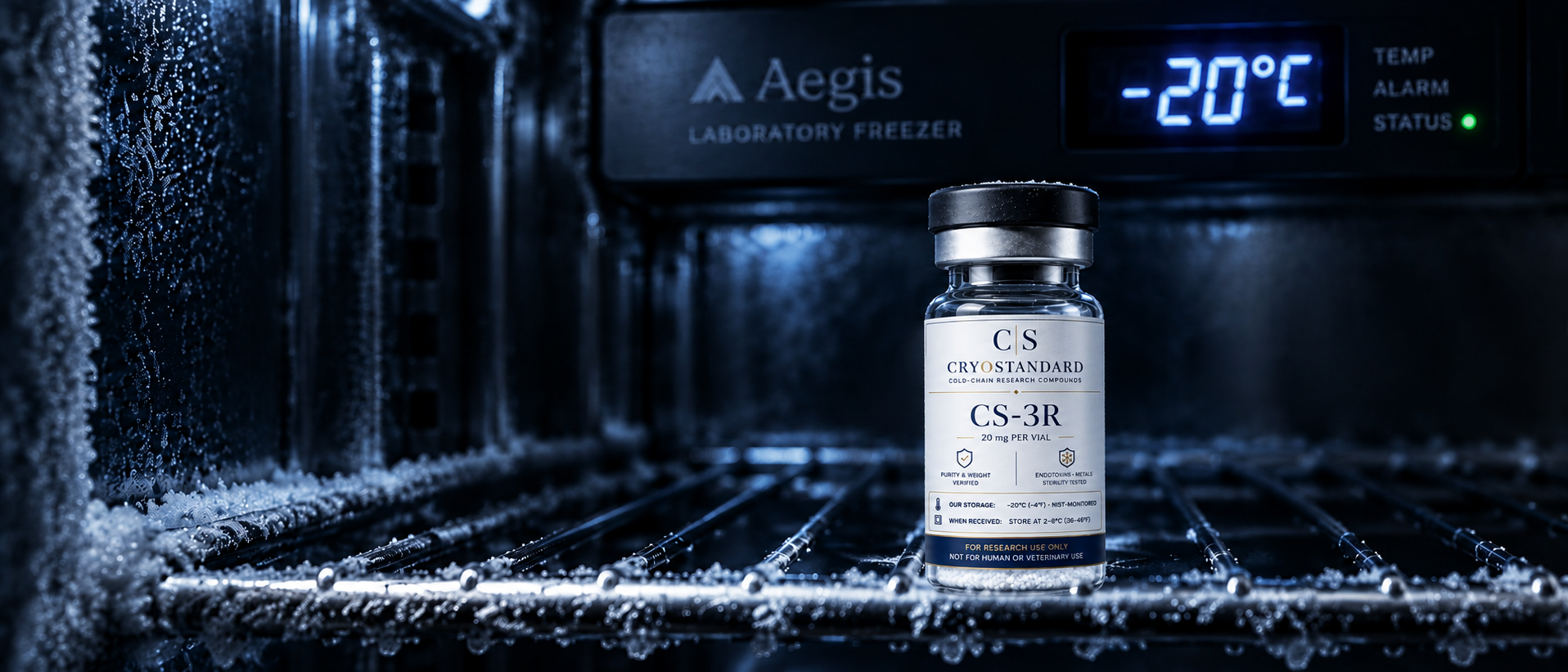
Peptide Shelf Life: How Long Research Peptides Stay Stable
Peptide shelf life depends on three things: the physical form (dry powder or solution), the temperature, and the amino acid sequence. Lyophilized (freeze-dried) peptides kept cold, dry and dark last far longer than the same peptide once dissolved. Typical guidance from peptide handling literature puts dry powder at −20°C in the range of months to several years, and solutions at days to weeks. This guide is for laboratory researchers working in vitro. It explains what drives those numbers, how to read them, and how to keep your materials consistent from the first vial to the last.
All compounds discussed here are research-use-only materials for in vitro laboratory work. They are not for human or veterinary use.
TL;DR
- Lyophilized peptides are the most stable form. Store them at −20°C, sealed, dry and away from light.
- Reconstitution starts a much shorter clock. Dissolved peptides are generally handled on a scale of days to a few weeks, and the sequence matters.
- Moisture, heat, light, oxygen and pH drive hydrolysis, deamidation, oxidation and aggregation.
- Define a discard date at reconstitution, aliquot, and avoid repeated freeze-thaw cycles.
- Stability is confirmed with analytical methods such as reversed-phase UPLC or HPLC, not by eye.
Table of Contents
- How long do peptides last? The short answer by form
- Why lyophilized peptides last longest
- What changes when you reconstitute
- What causes peptide degradation
- How to recognize degradation
- How peptide stability is tested
- A practical handling workflow
- The shipping gap most shelf-life figures ignore
- Our perspective
- Where to source cold-chain research compounds
- FAQ
- Sources
How long do peptides last? The short answer by form
No single number fits every peptide. Published ranges differ because sequences differ and because suppliers state conservative or optimistic figures. What most handling guides agree on is the order of stability:
| Form and condition | Relative stability | What to expect |
|---|---|---|
| Lyophilized, −20°C or colder, sealed, desiccated, dark | Highest | Months to several years, depending on sequence |
| Lyophilized, refrigerated | High for short periods | Suitable for short-term holding |
| Lyophilized, room temperature | Moderate | Days to weeks for most sequences |
| Solution, frozen in aliquots | Moderate | Better than refrigerated solution, still sequence-dependent |
| Solution, refrigerated (2 to 8°C) | Low | Days to a few weeks |
| Solution, room temperature | Lowest | Hours to days; avoid |
The ranges in the table reflect the general consensus of storage guidance rather than a guarantee for any specific compound. The authoritative number for a given lot is the one supported by its certificate of analysis and the stability data behind it. If a peptide contains residues prone to oxidation or deamidation (more on those below), expect it to sit at the shorter end of every range.
Why lyophilized peptides last longest
Water is the main reactant in most peptide degradation. In a freeze-dried cake, there is very little of it, and molecules have little mobility. That is why lyophilization is used to improve stability. It is not a complete shield, though: the residual moisture left in the powder, the storage temperature and any excipients still influence how fast degradation proceeds, as this overview of lyophilized and reconstituted stability explains.
For practical storage, that means:
- Keep it cold. Long-term storage at −20°C is the common standard. Lower temperatures can add margin for sensitive sequences.
- Keep it dry. Peptides are often hygroscopic. Cold vials pulled straight from the freezer and opened in a humid room pull in water from the air. Let the sealed vial reach room temperature first, then open it.
- Keep it dark and sealed. Light and oxygen feed photo-oxidation and oxidation of susceptible side chains.
- Keep it steady. A vial that cycles between temperatures is exposed to repeated condensation and thermal stress. Our own guide to reagent and peptide storage temperature covers how labs set this up.
What changes when you reconstitute
Dissolving a peptide opens every degradation route that the dry state suppressed. Hydrolysis needs water. Deamidation and oxidation run faster in solution. Dissolved molecules can also meet each other and aggregate, or stick to container walls. Microbial growth becomes possible too, which is why sterility matters alongside chemical stability.
The typical handling picture is:
- Refrigerated solution (2 to 8°C): days to a few weeks. Several vendor guides cite figures from about a week to about a month, which shows how much depends on the sequence.
- Frozen solution: better than refrigerated, but only if you freeze in single-use aliquots. Repeated freeze-thaw cycles damage peptides through aggregation and local concentration and pH shifts.
- Room temperature solution: treat as the shortest window. Keep bench time minimal.
The most useful habit is the one the research community keeps coming back to: set a discard date at the moment of reconstitution, based on both chemical stability and sterility. A fixed discard date makes experiments comparable from one week to the next, because every run uses material of known age. This is the point made in recommendations for the generation, quantification and storage of peptides.
Choosing a buffer and pH
Peptide solutions are pH-sensitive. Many sequences are happiest in slightly acidic, sterile buffers, while others (those with deamidation-prone residues) degrade faster at neutral to basic pH. Check the literature for your specific sequence before choosing a diluent. Use sterile, high-purity solvents, and filter-sterilize where your protocol allows.
What causes peptide degradation
The chemistry is well documented. Peptides degrade through chemical pathways such as hydrolysis, deamidation and oxidation, and through physical aggregation. Moisture, heat, light and pH drive these processes, and they accelerate most in aqueous solution, according to the 2016 peptide storage recommendations.
| Pathway | What happens | Typical triggers |
|---|---|---|
| Hydrolysis | Peptide bonds cleave, often at specific residue pairs | Water, extreme pH, heat |
| Deamidation | Asparagine or glutamine converts to an acidic residue | Neutral to basic pH, warmth, especially Asn or Gln followed by glycine |
| Oxidation | Side chains gain oxygen | Oxygen, light, metal ions, peroxides |
| Aggregation | Molecules clump into larger assemblies | Concentration, freeze-thaw, agitation, pH near the isoelectric point |
Sequence is the hidden variable
Two peptides stored identically can age very differently. Cysteine, methionine and tryptophan are prone to oxidation, and the same source notes that Asn or Gln followed by glycine may deamidate. When you plan a study, read the sequence first. A peptide rich in these residues deserves tighter handling: smaller aliquots, less headspace, shorter solution storage and an earlier discard date.
How to recognize degradation
Some changes you can see. Many you cannot.
Visible warning signs
- Powder that has collapsed, turned sticky or changed color, which can point to moisture uptake
- A solution that turns cloudy, forms particles or changes color
- Powder that no longer dissolves as it did on first use
Signs you only see in data
- A new or growing shoulder or peak next to the main peak on an HPLC trace
- A falling main-peak percentage over time
- Mass spectrometry signals that differ from the expected mass by a small increment, such as +16 Da, a pattern commonly associated with oxidation
- Drifting results in an assay that previously gave tight replicates
The absence of visible change proves little. A peptide can lose purity while still looking like a perfect white cake. If an experiment suddenly shows more variability, suspect the material and check storage records before rewriting the protocol.
How peptide stability is tested
Stability testing is how a shelf-life claim earns its number. The standard approach follows ICH-style principles and uses stability-indicating methods: analytical methods that separate the intact peptide from its degradation products. Reversed-phase UPLC or HPLC is the workhorse, often paired with mass spectrometry or UV detection, as described in this overview of stability-indicating methods.
Two concepts matter when you read a stability claim:
- Real-time studies. Samples are stored under the intended conditions and tested at intervals. This produces the most defensible shelf-life figure.
- Forced degradation. Samples are stressed with acid, base, oxidants such as hydrogen peroxide, heat or light. This shows which degradation products form and proves the method can detect them. The same source describes forced degradation as the way to identify pathways and validate method specificity.
For your own lab, a lighter version works. Run a baseline HPLC on a fresh lot, keep a retained aliquot at −20°C, and compare later. Our guide on reading purity and impurity data from HPLC shows how to interpret the peaks.
A practical handling workflow
Use this sequence for each new vial:
- Receive and log. Record arrival condition and temperature data. Move the sealed vial to −20°C promptly.
- Equilibrate before opening. Let the closed vial warm to room temperature so condensation does not form on the powder.
- Weigh or reconstitute quickly. Minimize time open. Use a sterile, appropriate solvent for the sequence.
- Aliquot immediately. Divide into single-use volumes in low-binding tubes.
- Label with a discard date. Include lot number, concentration, solvent and date.
- Freeze aliquots or refrigerate only what you will use soon. Never refreeze a thawed aliquot.
- Return unopened powder to −20°C. Reseal tightly, ideally with desiccant.
Preventing degradation: the short list
- Buy lyophilized material and reconstitute only what a run needs.
- Avoid frost-free freezers, which cycle in temperature. A steady freezer with a monitored probe is better.
- Limit freeze-thaw cycles to one.
- Protect from light, particularly for tryptophan-containing sequences.
- Flag oxidation-prone sequences and shorten their solution window.
- Keep temperature logs. If a run goes wrong, the log is your first piece of evidence.
The shipping gap most shelf-life figures ignore
A shelf-life number assumes the peptide was stored correctly the whole time. The weak point is often the stretch between the supplier and your freezer. A package that sits on a warm dock or in a delivery vehicle can lose weeks of stability before you ever open it. Suppliers rarely say how long a parcel sat at what temperature, so the number on the label may describe a storage history your vial did not have.
This is why records matter as much as the cold itself. Look for temperature documentation for the shipment, lot-specific certificates of analysis, and clear statements of the storage temperature used. For a closer look at what good monitoring records contain, see our guide to cold chain monitoring and what to record.
Our perspective
Shelf life is a chain, and a chain breaks at its weakest link. A lyophilized peptide can be stored perfectly for a year and still arrive compromised if the shipment spent a weekend without temperature control.
That is why we hold research compounds continuously at −20°C under NIST-traceable monitoring, and why we send storage and temperature records with each order. Our lots are tested for purity and sterility through third-party analytics, and the certificate of analysis travels with the material. Our aim is that the number on the label and the condition of the vial match.
For researchers, the benefit is less variability. When the starting material has a documented history, a surprising result points to the experiment, not to a mystery in the freezer chain. We design our process around that confidence.
Animal
Where to source cold-chain research compounds
If you are a qualified researcher or laboratory working in vitro, CryoStandard supplies research-use-only compounds held at −20°C with continuous NIST-traceable monitoring, shipped in insulated packaging, with lot-level purity and sterility testing and certificates of analysis. You can see how we run storage on our cold-chain standard page and how lots are verified on our quality and testing page.
Browse the research compounds catalog for specifications and COAs. Our products are for laboratory research only, never for human or veterinary use.
FAQ
How long does lyophilized peptide last at −20°C?
For most sequences, months to several years, according to common handling guidance. The exact figure depends on the sequence, residual moisture, and whether the vial stays sealed, dry and dark. The certificate of analysis and lot stability data are the best reference for a specific compound.
How long is a peptide good after reconstitution?
Typically days to a few weeks when refrigerated, and the range is wide because sequence and pH change the rate. Set a discard date when you dissolve it, and freeze single-use aliquots if you need longer. Do not refreeze thawed aliquots.
Can peptides be left at room temperature during shipping?
Dry peptides tolerate short room temperature exposure better than solutions, often for days to weeks, but the risk grows with heat, humidity and time. Long-term stability is best protected by continuous cold storage. If a package arrived warm, check the temperature records and confirm purity by HPLC before use.
What are the main causes of peptide degradation?
Hydrolysis, deamidation, oxidation and aggregation, driven by moisture, heat, light and pH. Sequences with cysteine, methionine or tryptophan oxidize more easily, and Asn or Gln followed by glycine can deamidate. Solutions degrade much faster than powders.
How do I test whether a peptide is still stable?
Use a stability-indicating method such as reversed-phase HPLC or UPLC, often with mass spectrometry, and compare against a baseline from a fresh or retained sample. Appearance alone is not reliable, because purity can fall without visible change.
Sources
- Recommendations for the generation, quantification, storage and handling of peptides
- Peptide stability: from lyophilized powder to reconstituted vial
- Stability-indicating methods for peptide drug analysis