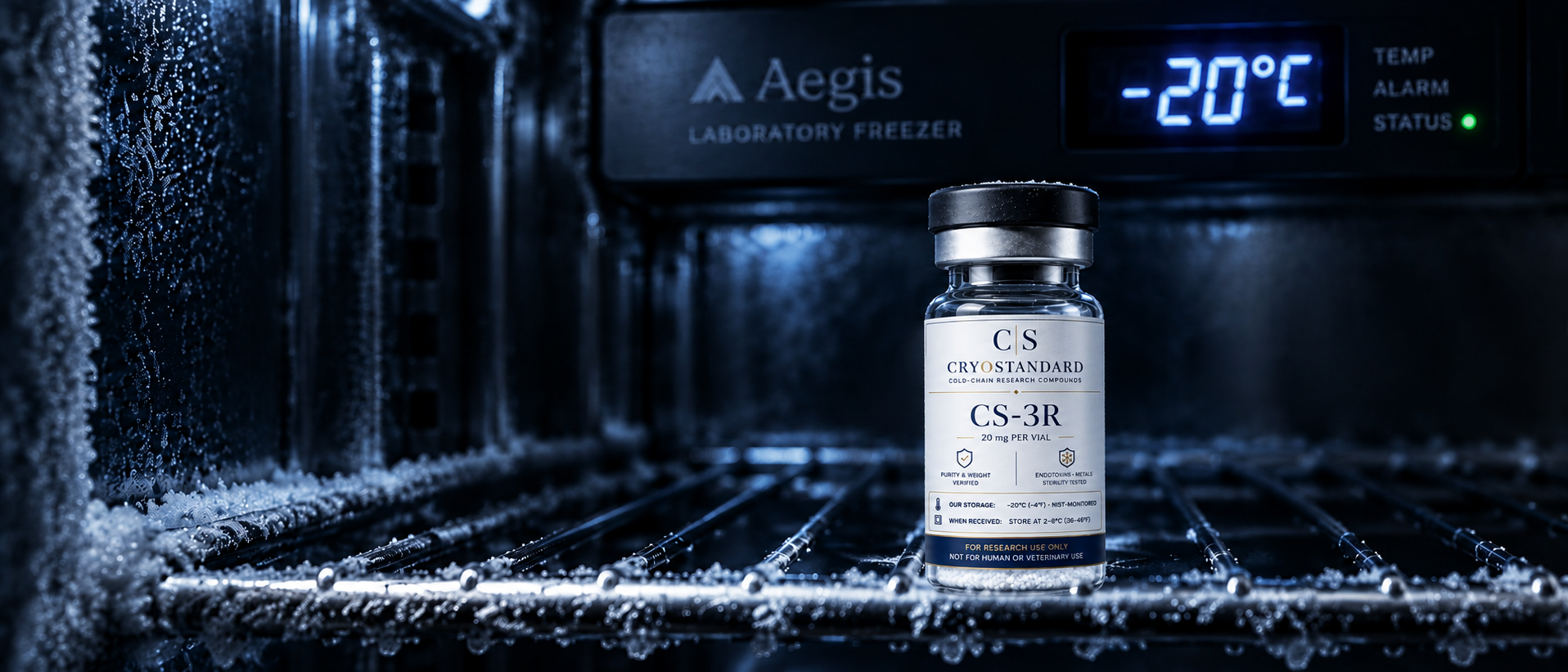
Compound Freezer Storage: Temperature, Setup and Handling
For long-term storage of lyophilized research compounds, a stable −20 °C freezer is the standard starting point, and −80 °C is used when you want extra margin. What matters as much as the number on the display is how steady that temperature stays, how dry the vial stays, and how many times a material is thawed. This guide covers the temperature, the freezer type, the packaging and the handling habits that keep in vitro materials consistent from the first experiment to the last. Everything here applies to research-use-only compounds handled in qualified laboratories, not to human or veterinary use.
TL;DR
- Store lyophilized compounds at −20 °C for long-term holding. Published guidance prefers −20 °C for the long term, and peer-reviewed recommendations extend the range to −20 to −80 °C.
- Avoid frost-free (auto-defrost) freezers. Their temperature swings during defrost cycles are harmful to compounds.
- Keep vials sealed, dry and dark, and let them reach room temperature before opening to limit moisture.
- Aliquot reconstituted solutions into single-use volumes before the first freeze, so each portion is thawed once.
- Stability depends on sequence, so follow the specification sheet and certificate of analysis for each compound.
Table of Contents
- What temperature should compounds be stored at?
- Lyophilized versus reconstituted: two different storage problems
- Choosing the freezer, not just the temperature
- Moisture, light and air: the other three variables
- Aliquoting and the freeze-thaw problem
- Sequence decides: compound-specific handling
- Records that make storage defensible
- Common mistakes to avoid
- Perspective
- Start from a documented cold chain
- FAQ
- Sources
What temperature should compounds be stored at?
The short answer is −20 °C for long-term storage of the dry (lyophilized) material. The UK’s National Institute for Biological Standards and Control (NIBSC) notes that dry compounds tolerate room temperature for days to weeks, but that −20 °C is preferred for long-term storage. A 2016 consensus paper on compound standards in the peer-reviewed literature goes further, stating that storage beyond six months is most effective as lyophilized material at −20 to −80 °C.
So the range is not one magic number. Think in tiers:
| Situation | Typical approach | Why |
|---|---|---|
| Receiving and short holding of dry vials | Cold, sealed, dark | Dry compound tolerates brief excursions better than solution does |
| Long-term holding of lyophilized compound | −20 °C or colder | Slows chemical degradation and microbial risk |
| Reconstituted stock, short term | 4 °C or frozen aliquots | Solutions degrade faster than dry powder |
| Reconstituted stock, longer term | Single-use aliquots at −20 °C or colder | Avoids repeated freeze-thaw |
The same consensus paper lists short-term storage of up to three months as liquid at 4 °C or frozen at −20 to −80 °C, and long-term storage beyond a year as lyophilized material at −20 to −80 °C. If your protocol runs for months, plan your temperature tier before the vials arrive, not after.
For a broader look at how temperature choices apply to reagents in general, see our practical guide to reagent and compound storage temperature.
Lyophilized versus reconstituted: two different storage problems
A lyophilized compound is a dry solid with very little water available to drive chemistry. A reconstituted compound is a solution, and that changes the risks. The 2016 consensus paper lists the main detriments of extended storage as loss of solubility, concentration change from evaporation, adsorption, microbial degradation, secondary structure formation and chemical modification. It also notes that storing compounds in buffers can make them susceptible to microbial growth.
In practice that means:
- Lyophilized material is your long-term reserve. Keep it sealed and frozen, and open it only when you need to.
- Reconstituted material is a working supply. Make only what the near-term work requires, and freeze the rest in measured portions.
NIBSC advises that compound solutions be held in sterile buffers at pH 5 to 6, with aliquots at −20 °C or colder. The consensus paper adds that reconstituted calibrator solutions are best kept frozen at ≤ −70 °C in sealed tubes, which is a reminder that for quantitative work, a colder freezer is a reasonable choice for solutions.
Choosing the freezer, not just the temperature
The appliance matters because compound stability depends on how steady the temperature is, not only on its setpoint.
Avoid frost-free freezers
NIBSC specifically advises against frost-free or auto-defrost freezers for compound storage, because their temperature varies enormously during the frequent automatic defrost cycles, which is deleterious to compounds. A manual-defrost or purpose-built laboratory freezer holds temperature more evenly. If a frost-free unit is the only one available, treat it as short-term holding at best and keep vials toward the back, away from the door and defrost zone.
Placement and loading
- Keep compound vials in a dedicated, labeled box, not loose in a door shelf or a bin that gets opened for other materials.
- Avoid overloading the freezer. Air needs to circulate, and a freezer packed with warm items takes longer to recover.
- Give high-value or irreplaceable lots their own position so that nobody digs through them while looking for something else.
- Record where each lot lives. A freezer inventory saves door-open time.
Verify the temperature, do not assume it
A built-in display shows the air near the sensor, not necessarily the temperature at your vial. An independent, calibrated probe or logger tells you what the box actually experiences. We explain what to capture in our guide to cold chain monitoring and what to record, and why traceable instruments matter in our note on NIST-traceable calibration.
Set an alarm band around your setpoint, and review the log after any power event, door left ajar or service visit. An excursion you know about is one you can document and assess. One you do not know about becomes unexplained variability in your data.
Moisture, light and air: the other three variables
Temperature gets the attention, but three other factors quietly decide whether a vial is still good in month six.
Moisture
NIBSC states that contamination with moisture greatly decreases the long-term stability of solid compounds. The most common way moisture gets in is opening a cold vial in a warm room, when condensation forms on the cold powder. The routine fix is simple:
- Move the sealed vial from the freezer to a desiccated space or the bench.
- Let it equilibrate to room temperature while still sealed.
- Wipe the outside, open, weigh or dissolve the amount needed, and close promptly.
- Return it to cold storage without leaving it out longer than necessary.
NIBSC also recommends that, after the desired quantity is removed, the vial be re-sealed preferably under dry inert gas before it goes back to the cold.
Light
Aromatic residues such as phenylalanine and tryptophan are susceptible to photochemical degradation, according to the 2016 consensus paper, which recommends amber or dark tubes for photochemically sensitive sequences. A closed freezer is dark most of the time, but vials sitting on a bench under bright lab lighting are not. Keep them in their box or in amber containers during handling.
Oxygen
Cysteine, methionine and tryptophan are prone to oxidation, and the same paper notes this conversion is accelerated during freeze-thaw cycles and at high pH. For particularly sensitive sequences it recommends an inert blanket gas such as argon or nitrogen in storage tubes. If your sequence contains these residues, add a gas step to your standard operating procedure.
Aliquoting and the freeze-thaw problem
The single most useful habit for reconstituted material is aliquoting. Each freeze-thaw cycle exposes a dissolved compound to ice-water boundary effects, solute concentration at the boundary, pH shifts in buffered systems and shear stress at the liquid-ice interface. All of these promote aggregation and reduce the soluble fraction. The data reviewed in the literature are striking: in recombinant MCP-1, a second freeze-thaw cycle caused roughly 50% loss, and six cycles in uncoated tubes left minimal recovery of substance P.
A workable aliquoting routine:
- Calculate how much solution each planned experiment consumes, plus a small margin.
- Reconstitute once, using sterile buffer in the pH range your compound tolerates.
- Divide into single-use volumes in low-binding or appropriately coated tubes, filled to a consistent level.
- Label each tube with compound, lot, concentration, date and aliquot number.
- Freeze promptly at −20 °C or colder, and thaw each tube once.
- Discard leftovers from a thawed aliquot rather than refreezing them.
The consensus paper also recommends preparing working dilutions from stock as close to the time of use as possible. Fewer intermediate stocks mean fewer places for degradation to hide.
Sequence decides: compound-specific handling
The amino acid composition and sequence are the primary determinants of stability, so handling should be compound-specific. The consensus paper describes the usual weak points: glutamine and asparagine can undergo deamidation, aspartic acid is sensitive to hydrolysis, and cysteine, methionine and tryptophan oxidize. These liabilities are laid out by residue, which lets you read a sequence and anticipate the risks.
This is why a single generic rule is never enough for compounds such as TB-500, retatrutide or GHK-Cu used as research materials. Each has a different sequence length, different residues and different solution behavior. Instead of copying a shelf-life figure from a general web table, work from three things:
- the specification sheet and certificate of analysis for the exact lot you hold;
- the residue-level risks above for that sequence;
- your own stability data under your buffer, concentration and container.
Our GHK-Cu 50 specification and COA page shows the kind of lot-level documentation to keep alongside your storage records.
Records that make storage defensible
Cold storage is only reproducible if you can show what happened. For each lot, keep:
- receipt date and condition on arrival, including any temperature record that shipped with it;
- the freezer ID, shelf position and logged temperature history;
- every opening: date, who opened it, quantity removed, whether gas was applied;
- reconstitution date, buffer, concentration and the number of aliquots made;
- any excursion, with duration and what you did about it.
Purity data belongs in the same file. If you want to read an HPLC report critically, our guide to HPLC-tested compounds and how to read purity and impurity data walks through the chromatogram and impurity profile.
Common mistakes to avoid
- Treating the fridge as the freezer’s equal for months. The consensus paper frames 4 °C as a short-term option for concentrated solutions, not a long-term plan.
- Opening cold vials immediately. Condensation is a quiet source of degradation.
- Refreezing a thawed solution. Each cycle costs soluble compound.
- Trusting the door display. Use an independent probe near the vials.
- Storing everything in one big stock vial. One shared vial means repeated exposure of the same material to air, light and thaws.
- Ignoring the shipping leg. A perfect freezer cannot repair a warm transit. Ask for the temperature record of the shipment.
Perspective
Most of the storage failures we hear about do not happen in the freezer. They happen between freezers: on a loading dock, in a courier van, on a bench while someone looks for a label. That is why we built our process around an unbroken chain rather than a single cold room.
Our approach is to hold research compounds at a consistent −20 °C under continuous NIST-traceable monitoring, ship them in insulated packaging, and send storage and temperature records with each order. Lot-level testing for purity and sterility, with third-party analytics and a certificate of analysis, means the material you put in your freezer arrives with its history attached.
We think a lab should be able to start its own storage protocol from a known baseline. When the starting point is documented, variability in an experiment can be traced to the experiment, not to a mystery in the supply chain.
Animal
Start from a documented cold chain
If you are setting up a freezer protocol for in vitro work, it helps to receive material that has been held at −20 °C throughout. Our cold-chain standard describes how we store and monitor, and our quality and testing page explains the third-party certificates of analysis that accompany each lot. Verified laboratories and professional researchers can browse the research compounds catalog. Our compounds are supplied strictly for laboratory research, never for human or veterinary use.
FAQ
Is −20 °C cold enough for compounds?
For lyophilized compounds, yes. NIBSC prefers −20 °C for long-term storage, and the 2016 consensus paper gives −20 to −80 °C as the effective range for storage beyond six months. For reconstituted solutions used in quantitative work, the same paper points to ≤ −70 °C in sealed tubes, so choose the colder tier when precision matters.
Can I use a frost-free freezer?
It is best avoided. NIBSC warns that frost-free freezers vary enormously in temperature during their automatic defrost cycles, which is deleterious to compounds. A manual-defrost or laboratory-grade freezer with an independent temperature log is the safer choice.
How long do compounds last in the freezer?
It depends on the sequence and the form. The consensus paper recommends that standard compounds ideally be stable for at least three years at −20 °C as a performance target, and that long-term storage beyond a year use lyophilized material. For a specific compound, rely on the lot’s specification sheet and your own stability data.
Why does freeze-thaw matter so much?
Each cycle concentrates solutes, shifts pH and stresses the compound at the ice interface, which promotes aggregation and lowers the soluble fraction. Published examples show large losses after only one or two cycles for some proteins. Aliquot into single-use volumes before the first freeze.
Should vials go in the fridge or the freezer on arrival?
For long-term holding of lyophilized material, the freezer. Keep the vial sealed and dry, and let it warm to room temperature before opening so moisture does not condense on the powder.
Sources
- NIBSC: Compound Storage
- Recommendations for the generation, quantification, storage and handling of compounds used for mass spectrometry-based assays (PMC4830481)
- Compound storage durations and freeze-thaw stability criteria (PMC4830481, alternate address)